
The most dangerous player in Japanese youth baseball is not always the biggest hitter. Sometimes, it is the kid on first base who has already taken two quiet steps toward second.
The pitcher looks home. The runner leans. A parent behind the backstop whispers, “He’s going.” Then the pitch leaves the hand—and so does the runner.
If your image of baseball in Japan begins with Shohei Ohtani and ends with professional stadiums, youth baseball may surprise you. The game can be smaller, dustier and much more dependent on speed, pressure and everybody knowing what to do next. One walk can become a run without a clean hit.
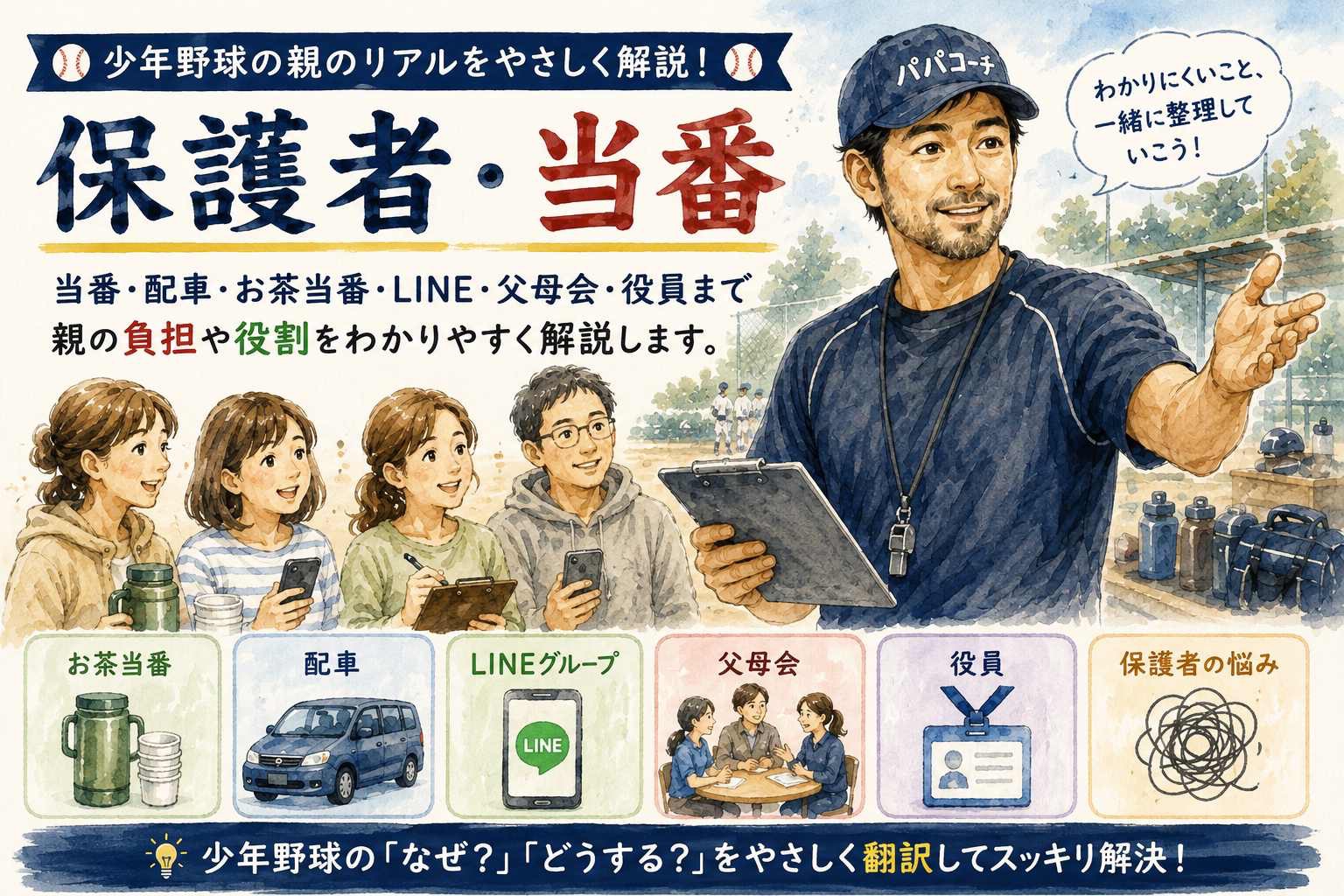
I am a Japanese “Papa Coach,” a father who helps coach youth baseball. This is not a rulebook for every team in the country. Japan has school teams, community clubs, sports associations and Little League organizations, and each has its own culture. What follows is the version of youth baseball in Japan I have seen from inside the field.
What does “youth baseball in Japan” actually mean?
First, a small translation problem. English speakers often use “Little League” to mean almost any children’s baseball team. In Japan, however, Little League is a specific organization. Many elementary-school players belong instead to local community teams, sports clubs or school-linked groups.
That matters because there is no single Japanese youth baseball experience. Practice days, parent duties, coaching style, fees and tournament rules can change from one team—or even one neighborhood—to the next.
Ask about the team, not just “baseball in Japan.” The uniform may look familiar. The weekly life around it may not.
Some teams practice lightly and welcome beginners. Others train for long hours and enter many tournaments. Some ask parents only to watch. Others depend on families for transport, scorekeeping, equipment, field preparation and team administration. Research on Japanese youth baseball also describes parents taking both “peripheral” and direct roles in team operations.
 初心者ママ
初心者ママWhat should a reader check first about “Youth Baseball in Japan: Culture, Training, and Why…”?
 パパコーチ
パパコーチStart with the actual situation, the applicable rule, and safety—not a stereotype.
Why base stealing matters so much in Japanese youth baseball
Here is the part that surprises many people: in elementary-level baseball, a runner can change the entire inning before the batter puts the ball in play.
Young pitchers are still learning to hold runners. Catchers are still developing footwork, transfers and throwing accuracy. Infielders may arrive late at the bag. Add a short youth base path and one aggressive runner becomes a problem shared by the whole defense.
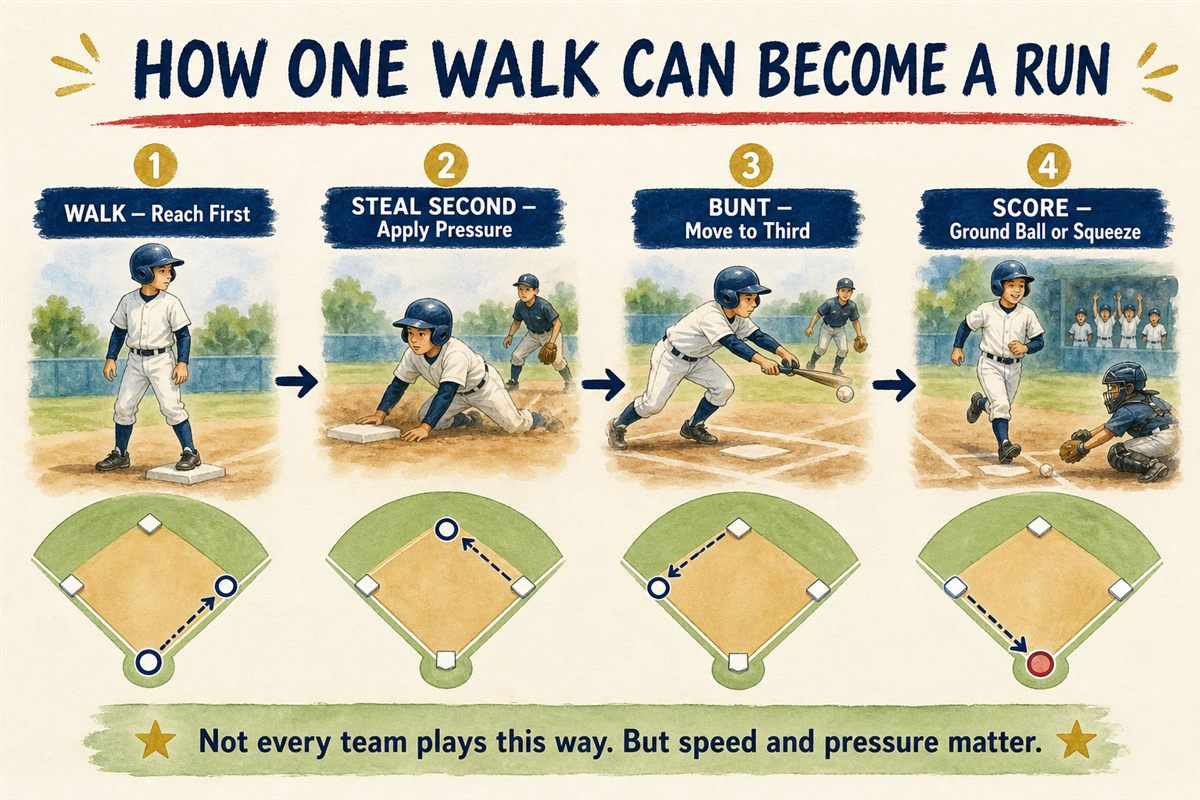
A walk is not “only” a walk. It may become a steal of second, a bunt to third and a run on a ground ball or squeeze. Even when the runner stays put, the threat changes the pitcher’s attention and the infield’s positioning. The offense is asking a very simple question: Can your defense execute under pressure?
Of course, not every Japanese team plays the same way, and aggressive running is not automatically good baseball. A reckless runner can give away an out. But in youth games, where throwing and receiving are still developing, stealing is often more than a speed contest. It is a strategy built on observation, timing and the possibility of an error.
The “ninja” part is timing, not magic
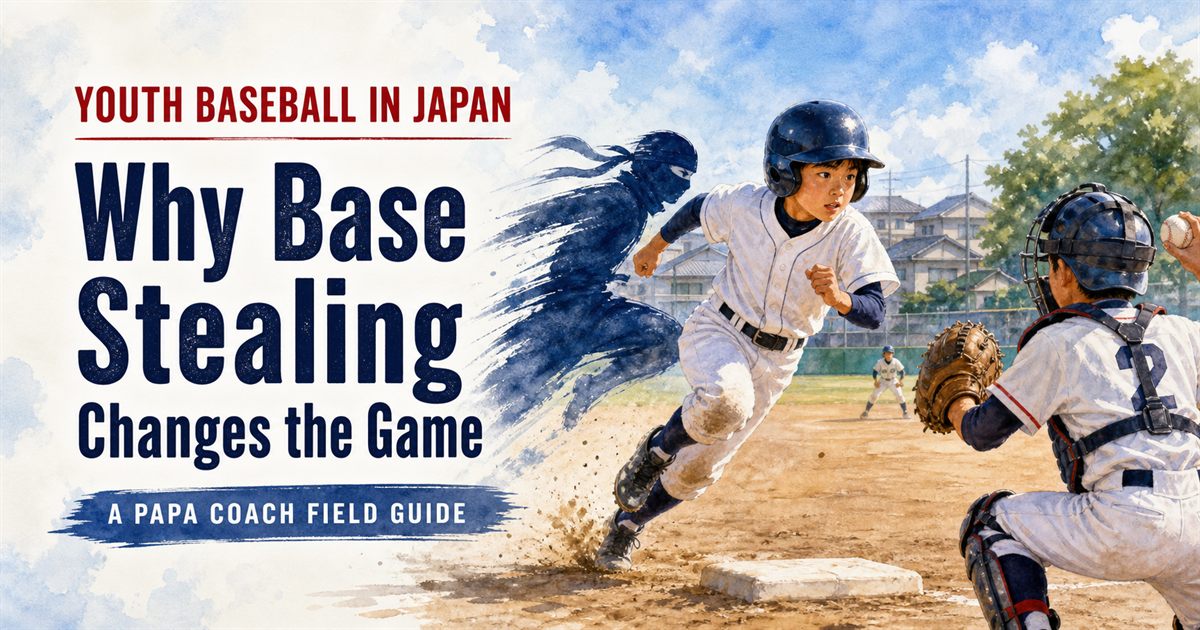
The ninja on our cover is a joke—but only partly. Good base runners do not simply sprint. They watch the pitcher’s feet, rhythm, eyes and pickoff move. They learn how far they can lead, when to return and when the catcher is likely to have a difficult throw.
In other words, the real trick is disappearing from first base before the defense is ready.
Japanese baseball culture is about more than repetition
Japanese baseball is famous for repetition: many ground balls, repeated defensive movements, synchronized warm-ups and careful field maintenance. That reputation is not invented. But repetition by itself does not explain what coaches are trying to build.
A player is also being watched between pitches. Does he listen? Does she cover the correct base? Does he back up a throw when nobody applauds? Does she help a teammate after an error? Can the bench stay connected to the game?
This is why a technically talented child may not automatically become the most trusted player. In team baseball, reliability has value. A home run is visible. Correct positioning on a throw that never comes is not—but coaches notice it.
初心者ママHow does “The parent role can feel like joining a…” change the answer?
パパコーチThe surrounding situation matters. Avoid turning one example into a universal rule.
The parent role can feel like joining a second team
A child joins the roster. Then the parents discover that they may have joined something too.
Depending on the team, families may help with rides, drinks, scorekeeping, umpiring, equipment, tournament communication or field setup. Sometimes these jobs are clearly explained. Sometimes they appear later in a group message, which is a wonderful way to make a new parent stare at a phone and think, “Wait—am I the first-base umpire on Sunday?”
This is not necessarily a warning. Parent involvement can create strong friendships and keep community teams affordable. It can also become exhausting when expectations are vague or one family carries too much. Japanese research and English-language reporting have both noted the substantial burden that youth sports can place on parents, particularly mothers.
What foreign parents should ask before joining
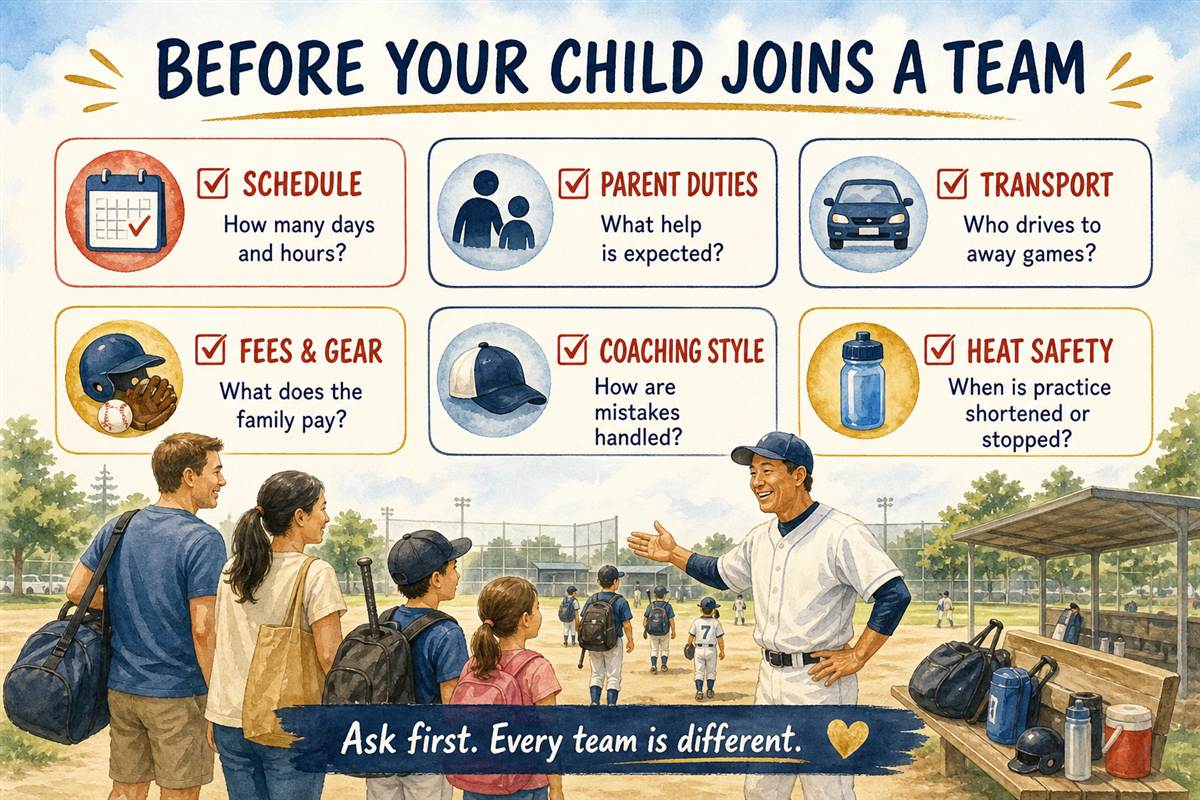
- How many days and hours does the team practice? Ask about normal weeks, tournament weekends and school holidays.
- What parent duties are expected? “Optional help” and a rotating duty roster are not the same thing.
- Who handles transportation? Away games may require group rides, early departures and parking arrangements.
- What will the family pay for? Ask about fees, uniforms, bags, tournament costs and team equipment.
- How does the coach respond to mistakes? Watch one full practice if possible. A team’s real culture appears after an error.
- What is the heat-safety policy? Japanese summers can be severe. Ask when practice is shortened, moved or stopped.
If communication is mostly in Japanese, ask whether another parent can help translate schedules and emergency messages. A welcoming team does not need perfect English. It does need patience and clear expectations.
What makes Japanese youth baseball worth experiencing?
For all the long practices and complicated parent group chats, there is a reason families stay.
You see children learn that baseball continues after their own at-bat. A runner studies the defense. A right fielder backs up first. The bench shouts for a teammate. Players rake the field they just used. Small actions begin to connect.
And then there is the game itself: a nervous pitcher, a runner dancing off first, a bunt rolling slowly toward third and ten children all moving at once. No home run. No superstar moment. Just baseball turning into a team puzzle.
That, to me, is the most interesting part of Japanese youth baseball. It is not simply that children practice more or bow more. It is that the game often teaches them to notice the next play before it happens.
A final note from Papa Coach
If you are an international family looking for a youth baseball team in Japan, do not search for the “most Japanese” team or the toughest one. Look for a place where your child can understand the expectations, make mistakes safely and still want to return next week.
Base stealing may be the heartbeat of an inning. Trust is the heartbeat of a team.
Sources and further reading
- Baseball Federation of Japan: discussion of youth baseball reform
- CiNii Research: parental roles in Japanese youth baseball
- Nippon.com: parental involvement in Japanese youth sports
- Japan National Tourism Organization: Baseball in Japan
Editor’s note: Team structures, playing rules and parent expectations vary by organization, age group and region. This article describes common patterns and the author’s field experience, not a universal national standard.